Here at last

Three o’clock in the morning. Terrible time to be awake. But awake I am. Lying in bed, my mind working too fast to sleep. I should just turn over and go back to sleep. Or lie here quietly and focus on my breathing. But I don’t, because one thought keeps circling to the fore: if Sesame is in difficulty when I check the goats in the morning, I will wish I’d checked her during the night.
I get up as quietly as I can, trying not to disturb Rob. I stumble in the dark, finding my work pants and jumper. The laundry door creaks loudly. I manage to lay my hand on the torch on the top shelf easily but before I turn it on I bang into the open door of the washing machine. Maisie has heard me and is at my side, wagging her tail with delight, always ready for an adventure. Her tail thumps the wall. I get us both out the door quickly, certain by now that Rob is wide awake and wondering at my obsession with goats.
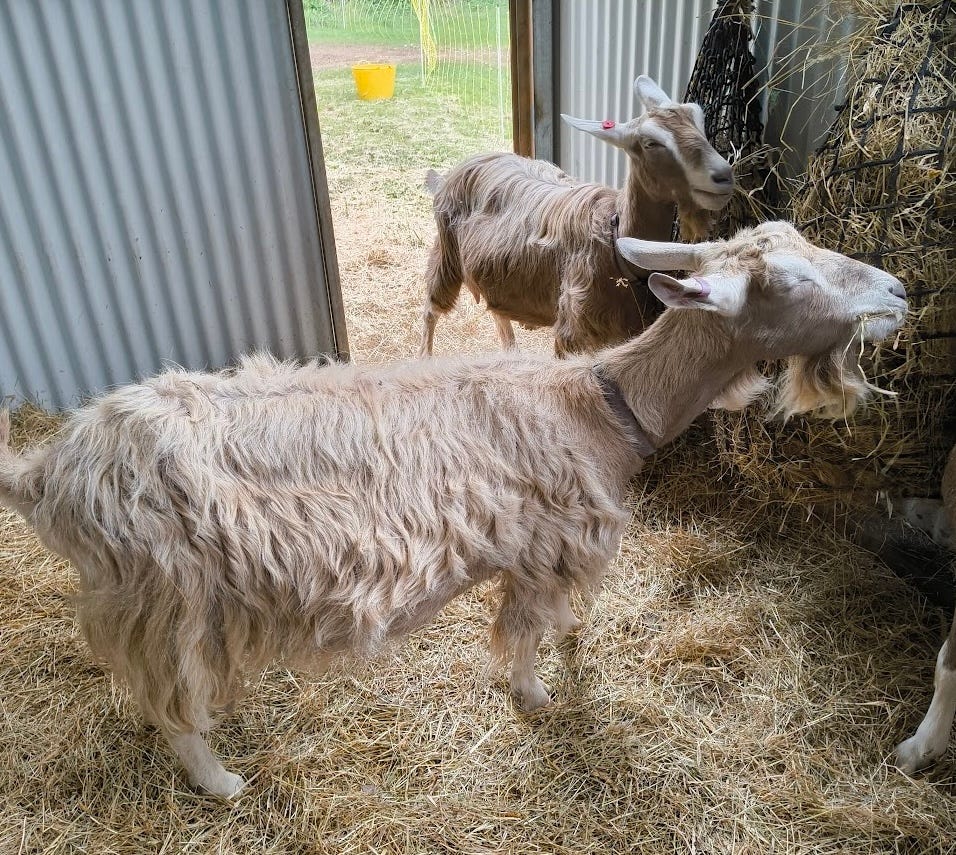
The sky is pitch black. Gentle breeze ruffles the karri leaves high above me. I hear the horses move across the paddock. (I have two horses here at present, Floss and her friend Magnum, but that is a different story.) The torch picks out their shapes standing by the gate watching me. I get to the goats. Sesame is lying just outside the shed. She stands up as I approach, struggling to her feet. She is large now. Her belly and udder swollen with late pregnancy. I go in through the shed and yard. Ashcroft bleats at me, ever hopeful of feed and scratches. Cinnamon looks at me from her bed in the straw but doesn’t bother to get up. The goats have become used to my all-hours visits this past couple of weeks. Despite my early doubts, both the does are pregnant. Both now round with it. Cinnamon is not due until next week. Sesame is past her due date. When this day dawns she will be at 155 days gestation - a goat pregnancy is 150 days plus or minus five days, so she is right at the end of the normal range. She bleats softly to me as I run my hands down her back. The ligaments by her tail have definitely softened but I can still feel them ever so slightly. Her udder is full. Her vulva is swollen and there is a drip from it that could be discharge. Or maybe she just weed. She leans her head into my hand as I rub her forehead. “Are you going to have your babies soon?” I ask her.
I answer myself: It must be soon. But not right now. Not tonight.
I call Maisie. Her pale yellow form appears out of the darkness and we go back to the house. Back to bed.
I sleep then. Wake at 6am. Check Sesame again before breakfast. I tell Rob that I think it will happen today. “I’m not entirely certain yet, but I think it will.” A little voice inside me says it could be wishful thinking.
I check her again a couple of hours later and am more convinced. I message my friend Lisa who is a vet and tell her I think Sesame is in labour. I need the reassurance of knowing she is available if need be. Lisa responds quickly: “Yay! Exciting! Xx.” I am reassured.
I hang around up near the goat shed and paddock. Rob and I work on a little fencing project near the chook pen. I keep staring at Sesame, watching her, while Rob bangs in posts. I’m not much help.
“There,” I say to Rob. “Look how she’s standing. That’s a contraction. She’s in labour.”
I go over and inspect her more closely. Her tail ligaments have completely ‘gone’. This is a sure sign that birth is approaching - it’s a loosening of the ligaments to allow the kids to pass through the birth canal. I pat Sesame. “Not long now girl,” I say. I try to sound reassuring. In my heart, I am slightly petrified. The dreadful experience with my goat Nutmeg last year has scarred me. Scarred me and scared me. Nutmeg had triplets, one of which was terribly deformed (‘inside out’ is the term for it). The deformed one and one other died. Ashcroft was the third triplet and the only one that survived. Then Nutmeg also died. It was awful. But for some reason I decided to try again and there’s no backing out now. I have two pregnant goats and one is now in labour. It could be hours yet, but it’s definitely happening. I message Lisa again: “I’m certain now. Early though. Her tail ligaments have completely disappeared and she’s clearly having contractions. So exciting!” Lisa responds: “Keep me posted!” I bounce back: “Oh, don’t worry, I will!” I’m so relieved to have her on the end of the phone.
Sesame paws at the ground, digging a nest. Inside the shed is a lovely hay-filled pen. She could be in there. She has access. She is opting for an area outside near an embankment. She paws away the larger rocks.
Rob and I go down to the house and have a cup of tea. What else to do! I drink my tea quickly. What am I thinking! I can’t relax in the house. I need to be up at the shed.
When I get back there is a fluid-filled balloon dangling from Sesame’s rear end. She is pacing up and down near her ‘nest’. I grab a couple of towels from the shed and sit near her. Ashcroft, now a one-year old wether, comes up and chews my hat, nibbles at my trousers. “Bugger off Ashcroft.” He ignores me. Leans into me. Watches Sesame. She turns her back on us. Cinnamon watches from the shed door then turns around to eat hay. I decide Ashcroft is a pain in the neck so put him and Cinnamon in the shed with some nice hay and shut the door. “Just you and me Sesame.”
I stand behind her, my hand lightly on her back. Then I remember how much I hated being touched when I was in labour and take my hand off her. I stare at her rear end as she strains. There is more sack bulging out now. It is intact. Inside it, I can see something black and white. Obviously a kid but I can’t tell what I am looking at. My view is clouded by the fluid and the spider web of rich red blood vessels on the membrane. I peer in closely. A hoof! That’s a tiny hoof. Relief floods through me; a hoof is exactly what I should see first. But then the sack and its contents disappear back inside Sesame. She strains. Walks. Strains. Again and again. The sack bulges out and then retracts. Again and again. The presentation is slightly different each time. Each time I can see more of the kid but each time it retracts. Then there, that’s a nose and mouth! Tiny tongue hanging out. Tiny teeth. Still contained within the intact sack. It’s all the right way up, presenting as it should. I wonder how it can possibly be alive. So weird to see a mammal completely immersed in fluid like this. So weird and yet so normal. The way we all start life, immersed in fluid. Then I notice a flicker of an eyelid. It’s definitely alive. Sesame’s contraction passes and the whole bag slips back inside her. I wonder if the kid is too big.
Birth is such a normal thing yet so very extraordinary. As I write that I know it doesn’t make sense, to call something normal and extraordinary at the same time. Miraculous yet everyday. Common yet, in our modern lives, rarely witnessed, unless you are among a handful of professions: doctor, midwife, vet, animal breeder, farmer. But for most of us, rarely seen. I don’t need all the fingers on one hand to count the number of times I have witnessed a birth. I am way out of depth here, despite the books and blogs read, the videos watched. Here now, I am watching it in real life. In every detail.
I message Lisa again and again. Sending photos of progress. She reassures me that everything is normal. Sends me heart emojis.
Sesame lies down. It’s painful to watch her lower her cumbersome labouring body to the ground. She braces against her front feet and pushes with everything she has. She groans. Low and urgent. The sack emerges again and this time stays out. That’s the kid’s head. Sesame struggles to her feet. Moves around. Strains. Pushes. And out it comes in a slither. I catch it on the towel, determined that it not be born in the dirt. Sesame turns around, breaking the umbilical cord as she does so. She licks the kid forcefully and bleats gently. I help her clear the membranes from around the kid’s nose. They are remarkably tough. The kid breathes. Coughs. Shakes its head. I peer between its legs. It’s a boy. I’m disappointed about that but in this miraculous moment don’t really care.
Sesame is straining again. I grab another towel and catch the second twin as he slithers out - yes, another boy. I wonder how I will be able to tell them apart and then notice the second born has wattles on his neck. My goats are Toggenburgs and they sometimes have wattles, although none of my other goats do. (Wattles are little dangly bits of skin on their necks.) I move the second born around close to the the first, which is already trying to find his feet. Sesame gets to licking the second. He too coughs, ridding his airway of amniotic fluid.
Cinnamon and Ashcroft are banging on the shed door, so I open it and let them out. Ashcroft comes over. He hides behind me as he peers at the newborns. Cinnamon takes one look and retreats back inside.
It’s raining by this time and my wet shirt is stuck to my back. Sesame’s coat is damp. “Come on Sesame, let’s get these little boys inside where it’s warm and dry.” I pick them up, one in each hand. They bleat. Quiet little mews of concern at being taken from their mother. I can feel their hearts beating. The warmth of life inside them. Sesame follows me as I carry them inside.
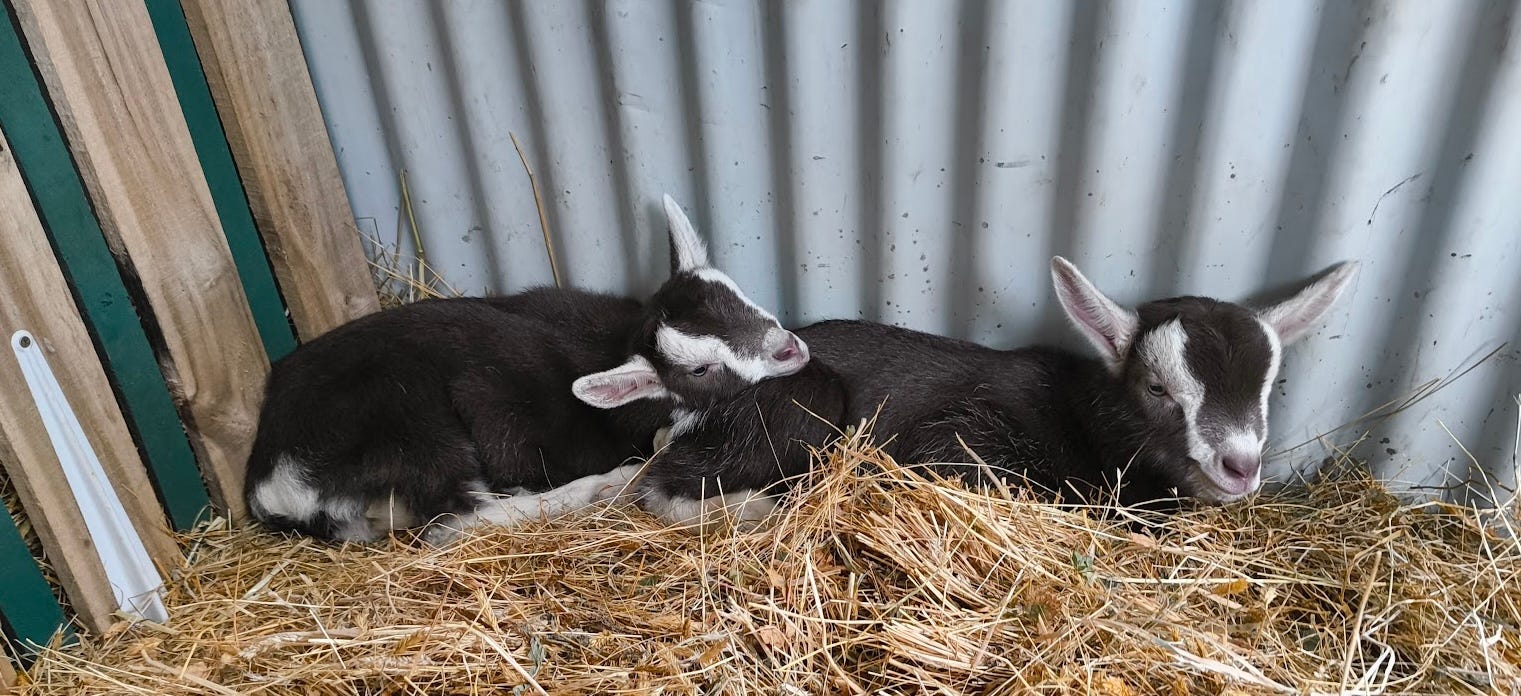
I sit on the hay and watch as they find their feet and search for Sesame’s teats. I’m flooded with relief and goodwill and, yes, love. I wait until they have both had a drink and I’m satisfied that Sesame is well before I leave them be. Later when I come back, Sesame has birthed the placenta and the boys are snuggled up in the hay sleeping. I call them Boo (because of the way he kept peaking out of the birth canal and then disappearing) and Berry (because my daughter suggested it) and this is the B litter of my tiny Karribridge Toggenburg stud. They are insanely cute. I look at Cinnamon’s swollen belly and wonder what next week will bring.
See you outside,
Jill